Authorship / September 17, 2026 / 12 min read
Writers Shouldn’t Have to Prove They’re Human
How writers can use AI without giving up authorship, and why keeping a record of the process may matter more than trying to “sound human.”
By Matthew Lane
I came across a Reddit post recently asking writers a question that would have sounded completely bizarre a few years ago. The headline was, “Have AI allegations made you change your writing process?” The author was working on a magazine article about AI and writing and wanted to know whether the recent accusations around AI use had started changing the way people actually work.
Were writers saving more versions of their drafts? Were they changing software so they could demonstrate how a piece developed? Were they avoiding em dashes because apparently we’ve reached the point where punctuation that has existed for hundreds of years is now considered evidence of ChatGPT? The author writes by hand and said they had started keeping and organizing their notebooks in case they ever needed to show them.
That was the part that really stuck with me. Not the notebooks themselves, which are probably worth keeping anyway, but the idea that somebody sitting down to write fiction now has somewhere in the back of their mind the possibility that they may eventually need to prove they wrote it.
There’s something profoundly backwards about that. Every writer develops habits over time, including certain punctuation, sentence structures, rhythms, words they overuse, strange little constructions that probably wouldn’t survive a copywriting course but become part of how that particular person sounds. Those things used to be fingerprints. Now some of them are apparently evidence for the prosecution because language models learned many of the same patterns by ingesting enormous amounts of human writing.
So we have human beings changing the way they naturally write because machines learned to imitate human beings, and now the human beings are worried that writing like themselves will make them look like the machines. It’s ridiculous. I understand why people are nervous about it, especially when accusations can affect publishing opportunities or somebody’s reputation, but I hate the idea of a writer deleting an em dash they genuinely wanted because they’re imagining some stranger on the internet squinting at it suspiciously.
Once you start doing that, where does it stop? Do you intentionally make the prose clumsier? Avoid certain transitions? Make sure you leave a typo in every few pages so everybody knows there was a carbon-based life form involved?
This subject happens to land directly in the middle of something I’ve been thinking about while building Skeleton Draft. Full disclosure, Skeleton Draft is my app, and it grew out of a writing process I had been developing for myself for roughly 25 years. I’ve always been extremely structural in the way I approach stories. I tend to work from large pieces toward increasingly smaller ones, moving through acts, chapters, scenes and beats until eventually I’m down inside the actual writing.
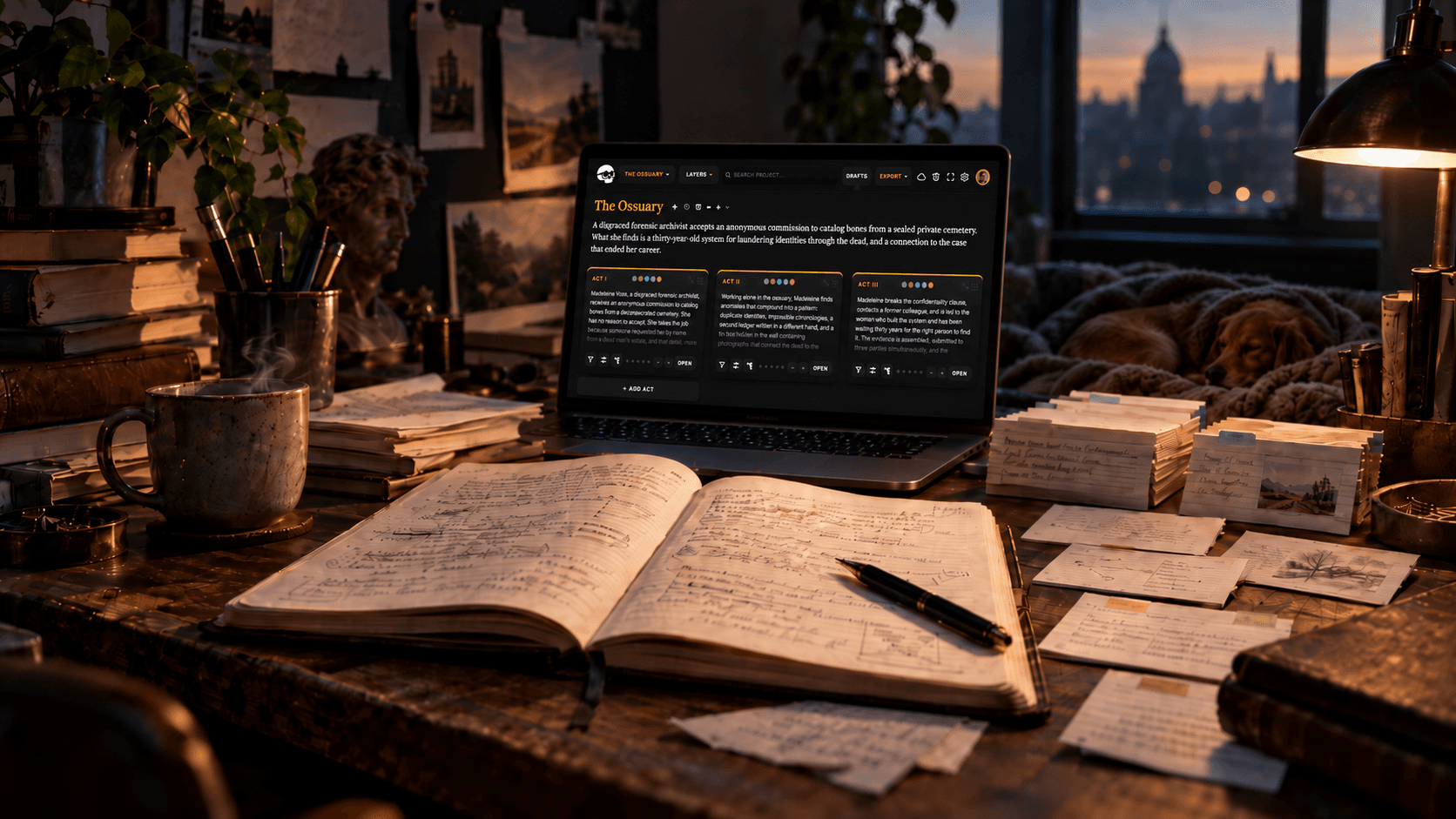
For years I was basically recreating some version of that system every time I started something, using index cards, documents, outlines, notes and whatever software happened to be useful at the time. Eventually I realized I had developed a fairly specific process of my own and started wondering what it would look like if the process itself were the software.
Skeleton Draft is essentially that. It’s an index card based writing environment with drafting built directly into it, so the planning and the writing aren’t living in completely separate worlds. You can work at the act level, then chapters, then scenes, then beats, and eventually the draft itself, with prose and screenplay modes available either separately or alongside one another.
The important thing for me is that you don’t have to make anything good when you first put it down. You can dump something rough into an act, figure out what the chapters underneath it are doing, move into a scene and get more specific, then keep working your way down until you eventually have enough material that the thing begins assembling itself into an actual draft.
It’s called Skeleton Draft because that’s what I’m trying to get to first. I don’t need beautiful skin and perfect hair while I’m still trying to figure out where the fucking bones go.
AI came into the app because there are parts of that process where it can be genuinely useful, but I’ve never been interested in having it become the writer. I use AI constantly for all kinds of things, and I obviously think it’s an extraordinary technology, but when I’m writing a story I still want the ideas and the writing to be mine.
What interested me was figuring out how small I could make the AI’s job while still getting something valuable from it. Skeleton Draft has a Distill function, for example, that looks at something you’ve already written and reduces it to a short logline for the corresponding index card. I might ramble for a page about what a scene is doing because I’m figuring it out as I type, then hit Distill and get the one-line version I actually need when I’m looking at the project from thirty thousand feet.
Seed works within the hierarchy in a similar way. If I’ve worked out a chapter and there are three scene cards beneath it, Seed can derive three short scene loglines from the material I already wrote. The same relationship continues farther down the structure. The point isn’t to ask, “What should happen next?” I’m trying to get material I’ve already created into a form that helps me see and navigate it.
Refine is even less glamorous, which is exactly how I want it. It fixes spelling, punctuation, grammar and obvious mess without taking the opportunity to audition for the role of author. I dictate a lot, and anyone who has ever worked from voice transcription knows what a fucking disaster that can look like before cleanup.
I want to be able to throw that material down while the idea is moving and deal with the debris afterward without stopping every thirty seconds to repair a sentence. Refine is there for that. It has very strict boundaries because the last thing I want is to ask for punctuation cleanup and discover that the software has helpfully improved my character’s motivation while it was in there.
Clean the sentence. Don’t have an opinion about my movie.
There’s also an Adapt function once you reach the drafting side. If I have written something in prose, it can convert that material into Fountain screenplay format. It identifies dialogue, character names, action and scene headings and does the tedious translation between forms while being instructed to remain extremely spare and faithful to the source.
That has become one of the clearest examples for me of where AI can be useful without becoming creatively invasive. Formatting a screenplay from material I already wrote isn’t the part of screenwriting that gives me any particular sense of artistic fulfillment. I don’t need the spiritual satisfaction of manually capitalizing a character name 140 times. If software can handle that while leaving the actual content alone, wonderful.
The same applies to the other AI functions. I’m interested in maintaining momentum, especially during the period when a story is fragile and I’m trying to get it out of my head before my attention disappears somewhere else. If a tool can remove some of the stopping and starting without making creative decisions for me, that’s useful.
The part of Skeleton Draft that connects most directly to that Reddit question, though, is everything the app keeps behind the writing. It has extensive version history for the cards and the drafts, it keeps the project backed up in more than one place, and it records the AI actions you choose to run.
That means the history of a project contains the messy development instead of preserving only the clean thing sitting at the end. There’s a record of what I wrote, what changed, which versions existed before the current one, when an AI function was used and what that function produced.
From that history, Skeleton Draft can export an authorship document comparing user-authored material with AI-assisted material and showing the chronological development of the work. I started thinking of it as an authorship ledger, which sounds ridiculously serious for something that may contain three weeks of me trying to decide whether a character walks into a bar before or after lunch, but that’s essentially what it is.
What I like about that approach is that it moves the conversation away from guessing. If somebody thinks a piece of writing “sounds AI,” I don’t particularly care what their theory is about em dashes or sentence length or whatever stylistic tic has become suspicious that week. I have the history.
You can see the rough material. You can see the cards. You can see the scenes developing. You can see the drafts changing. If I used Distill on something, there it is. If I ran Refine, there it is. If I adapted a piece of prose into screenplay format, that action is part of the record too.
You don’t have to infer how the thing came into existence by staring at the finished paragraph like you’re examining blood spatter. The development of the work is sitting right there.
And to be clear, AI is completely optional in Skeleton Draft. You can shut it off and use the same structure manually. Acts, chapters, scenes, beats, drafts, version history, project backups and the rest of the writing environment don’t depend on having an AI involved.
I care about that because I don’t think a writer should have to surrender part of the creative process just to use modern writing software. AI should be something you call when you have a specific job for it. I don’t want it hovering over every sentence, offering to improve things nobody asked it to improve.
When I need it to summarize something, I can ask. When I need some ugly dictated prose cleaned up, I can ask. When I want material converted into screenplay format, I can ask. Then it can go away again.
There are plenty of products headed in the opposite direction, and clearly people want them. You can ask AI to develop characters, brainstorm plots, generate scenes, write dialogue, continue chapters and produce enormous amounts of prose. I’m not particularly interested in arguing with anybody about whether they should use those tools. People can write however they want.
It simply isn’t the problem I was trying to solve. I built Skeleton Draft because I want to write, and because after doing this for most of my life I know how easy it is for the machinery surrounding writing to become its own obstacle.
Organization becomes an obstacle. Formatting becomes an obstacle. Rewriting the same information at different levels of an outline becomes an obstacle. Losing track of versions becomes an obstacle. Sometimes the distance between having an idea and having an actual draft feels absurdly long, and I wanted software that shortened that distance without deciding it should contribute a few ideas of its own along the way.
That’s why the authorship side of the app has become more interesting to me than I originally expected. I don’t love that writers are starting to think about proving their humanity, and I really don’t want people training themselves out of their natural writing habits because certain characteristics have become associated with language models.
I would rather write however I fucking write and let the record show where it came from. That seems healthier than letting fear of an accusation crawl backward into the creative process and start changing the work before anybody has even read it.
Maybe that becomes normal eventually. Not writers constantly defending themselves, hopefully, but creative software doing a better job of preserving provenance. We already expect version history from plenty of professional tools because it’s useful to know how something changed. Extending that idea to authorship doesn’t strike me as particularly radical.
Keep the drafts. Keep the changes. Keep the AI interactions if there are any. Let the writer decide whether they ever need that information.
Mostly, I’d like us to reach a point where none of this is very interesting. I’d like AI to settle into whatever role it ultimately has in writing and for the hysteria around detecting it by punctuation and vibes to burn itself out.
Until then, though, I’m glad Skeleton Draft keeps the receipts. I’d much rather have a boring chronological record showing exactly what happened than spend a single second wondering whether I’m still allowed to use an em dash.